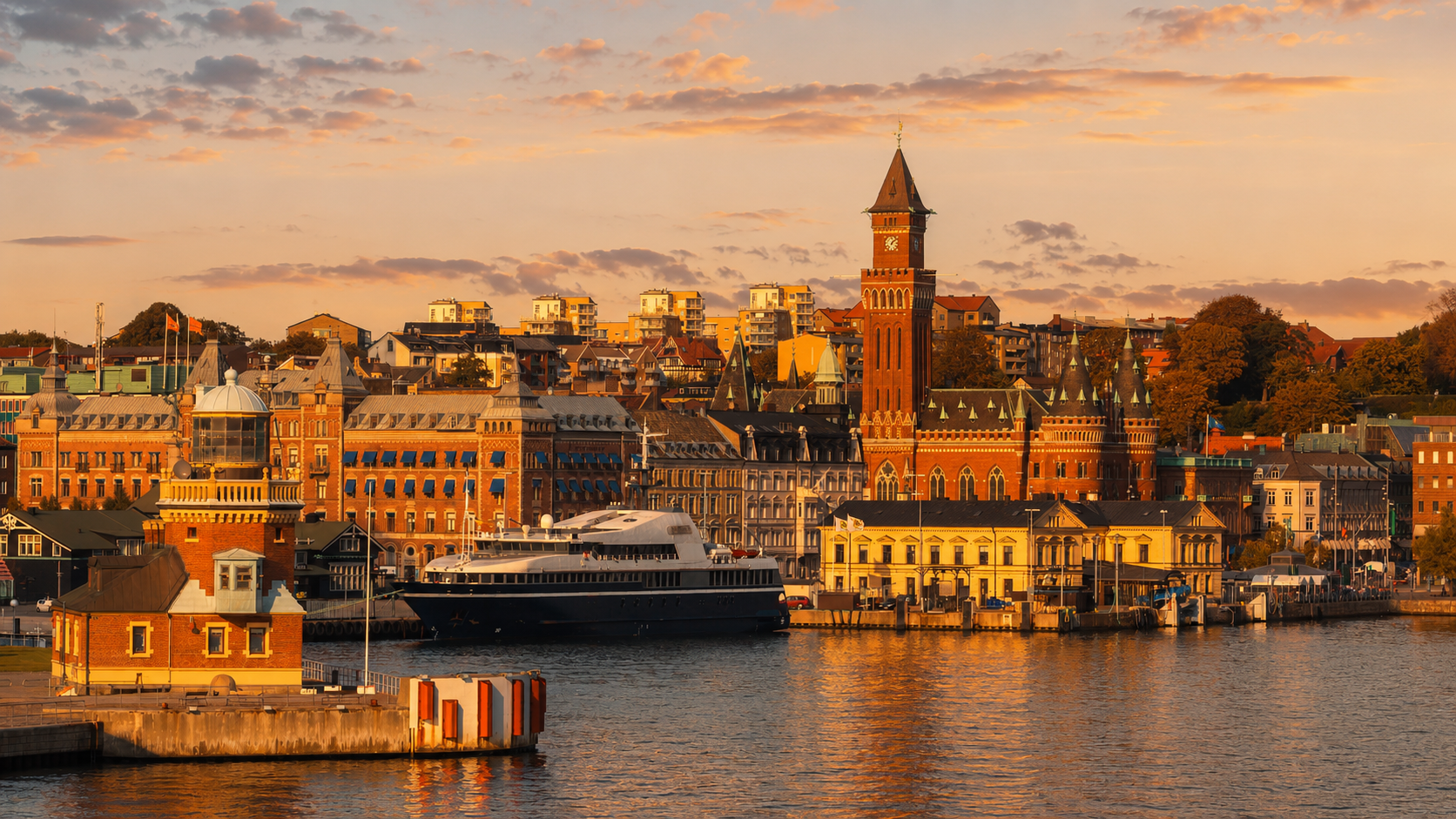
Helsingør, Denmark: Where Renaissance History Meets the Øresund
Helsingør is a city shaped by water. Standing near the harbour, with ferries sliding back and forth across the narrow Øresund and the Swedish coastline clearly visible beyond them, Denmark suddenly feels connected to the rest of Scandinavia in a very physical way. Helsingborg lies only a few kilometres across the strait, close enough for buildings on the opposite shore to become part of the everyday view.
Yet Helsingør is much more than a ferry port. Behind the waterfront, narrow streets run between old townhouses in muted reds, yellows and ochres. Café tables appear beneath timber-framed façades, bicycles lean against centuries-old walls, and church towers rise above tiled roofs. Then, at the edge of the city, Kronborg Castle changes the scale entirely. Its towers and pale stone walls command the entrance to the Baltic, just as they did when passing ships brought enormous wealth to the Danish crown.
 Photo by tommao wang on Unsplash
Shakespeare gave this place another identity by setting Hamlet at Elsinore, the English name for Helsingør. But the real city is more interesting than its literary shadow suggests: compact, cultured and distinctly maritime, with Renaissance history sitting beside contemporary architecture and an active working harbour.
Kronborg Castle and the History of Helsingør
Helsingør's fortunes were transformed in the 15th century when the Danish crown began collecting the Sound Dues from ships passing through the Øresund. The city's strategic position made it one of Northern Europe's important maritime crossroads, bringing sailors, merchants and money through its streets.
Kronborg Castle became the great architectural expression of that power. The Renaissance fortress occupying the headland today was largely created under King Frederik II in the late 16th century, replacing an earlier stronghold known as Krogen. Its location explains everything: from the ramparts, the narrow channel between Denmark and Sweden feels remarkably small.
 Photo by Nick Karvounis on Unsplash
Kronborg is now a UNESCO World Heritage Site, internationally associated with Shakespeare's Hamlet. Walking through its courtyards and cavernous casemates, however, the castle's military and commercial history feels every bit as tangible as the fictional tragedy.
Exploring Helsingør Old Town
The historic centre rewards slow wandering. Around Stengade and the surrounding lanes, Helsingør retains one of Denmark's appealing concentrations of historic urban architecture. Half-timbered houses sit beside later merchant properties, while small courtyards and passages reveal themselves between the busier shopping streets.
One of the city's defining landmarks is Sankt Olai Church, Helsingør's cathedral, whose history reaches back to the Middle Ages. Nearby, the former Carmelite monastery offers another window into the city's pre-Reformation past.
 Photo by Danny Chen on Unsplash
What I find most distinctive here is the contrast between grandeur and everyday life. Helsingør never feels preserved behind glass. Residents shop and cycle through streets that carry centuries of history, and within a few minutes you can move from medieval architecture to the railway station, harbour and ferry terminal.
A Danish Harbour City Looking Toward Sweden
Helsingør lies in northeastern Zealand, roughly 45 kilometres north of Copenhagen, at one of the narrowest points of the Øresund. The municipality has a population of around 63,000, while the urban centre itself is smaller, giving Helsingør the atmosphere of a manageable coastal city rather than a Copenhagen suburb.
Sweden is a constant presence. Ferries make the short crossing to Helsingborg throughout the day, and watching them manoeuvre through the strait is part of the rhythm of the waterfront. That connection has influenced Helsingør for generations, creating a border-town character unusual elsewhere in Denmark.
The geography also makes the city an easy addition to a Copenhagen itinerary. Trains connect the capital with Helsingør, while the coast north of Copenhagen offers beaches, woodland and affluent seaside communities along the way.
Maritime Culture and Modern Architecture in Helsingør
The harbour district shows how successfully Helsingør has moved beyond relying on its historic centre alone. The M/S Maritime Museum of Denmark is built largely underground around a former dry dock, allowing Kronborg to retain visual dominance over the waterfront. Its angular passages descend around the old dock rather than competing with the castle above.
Close by, Kulturværftet occupies former shipyard buildings that have been transformed into a cultural centre. This part of Helsingør feels deliberately raw in places: brick, steel, dockside spaces and remnants of industrial infrastructure sit alongside exhibitions, performances and public gathering areas.
That combination gives the waterfront an identity separate from the old town. Helsingør's maritime story did not end with sailing ships and Renaissance kings; shipbuilding and ferry traffic became later chapters, and the harbour still feels connected to working life on the Øresund.
Helsingør Weather and the Best Time to Visit
Helsingør has a temperate coastal climate, with the Øresund moderating conditions while also bringing wind and quickly changing weather. Summers are generally mild rather than intensely hot, and the long Nordic evenings make June, July and August particularly appealing for walking between the old town, Kronborg and the waterfront.
Late spring is quieter and often rewarding, especially as outdoor cafés return to the streets and the days lengthen dramatically. September can also be attractive, with softer light and fewer peak-season visitors. Winter creates an entirely different Helsingør: darker, colder and more atmospheric, particularly around Kronborg when low skies settle over the strait.
For a first visit, late May through September offers the easiest conditions for combining museums, historic streets and time outdoors. A light waterproof layer remains useful even in summer; coastal Danish weather rarely feels obliged to follow the forecast.
Danish Language, Currency and Everyday Culture
Danish is the official language, although English is widely understood, particularly in hotels, restaurants, museums and other visitor-facing settings. The proximity of Sweden also means Swedish voices are hardly unusual around the harbour and shopping streets.
Denmark uses the Danish krone (DKK), not the euro. Card and contactless payments are deeply embedded in everyday life, so visitors can comfortably manage most transactions without carrying much cash.
Culturally, Helsingør shares the understated informality found across Denmark. Cycling is part of daily transport, public spaces are generally well maintained, and social life spills naturally into cafés, harbour areas and cultural venues when the weather cooperates. The city feels organised without becoming sterile, partly because its medieval street plan and maritime edges continually interrupt any sense of uniformity.
Why Helsingør Deserves More Than a Day Trip
Helsingør is close enough to Copenhagen to visit in a day, but staying longer changes the experience. Once the museum crowds thin and the afternoon visitors head back south, the relationship between town, castle and sea becomes easier to appreciate.
Come for Kronborg and the world of Hamlet, certainly, but leave time for everything surrounding it: old streets worn smooth by centuries of movement, shipyard architecture given a second life, ferries crossing beneath northern skies and Sweden glowing across the water after dusk. Helsingør's appeal lies in those layers—and in how naturally the city continues to live among them.
1) Sport & Action
Helsingør is unusually good for an active city break because the historic centre sits directly on the Øresund, while forests and the North Zealand coast begin almost immediately outside town.
Coastal cycling toward Hornbæk is the strongest all-round activity. Follow the coast northwest through Hellebæk toward Hornbæk, combining sea views, woodland and small coastal communities. Nordkyststien / National Cycle Route 47 continues along the north coast and runs through Hellebæk Skov and Teglstrup Hegn; the full coastal route toward Hundested is about 68 km. ([Naturstyrelsen][1]) Expect roughly 150–300 DKK/day for a conventional rental bike and around 300–500 DKK/day for an e-bike where available; verify current rental rates before booking.
Sea kayaking and SUP on the Øresund are particularly attractive on calm summer mornings. The shoreline around Helsingør and Snekkersten gives you views across the narrow strait to Sweden, but this is genuine open water with shipping traffic, currents and rapidly changing wind rather than a sheltered recreational lake. Guided paddling typically runs around 400–800 DKK, with independent SUP/kayak rental generally around 150–300 DKK/hour where available.
For running, Teglstrup Hegn–Hellebæk Skov is excellent: lakes, mature woodland and rolling forest tracks only about 4 km northwest of Helsingør. The Danish Nature Agency also maintains a 2.5 km introductory orienteering course with 30 controls in the area.
Helsingør also has Multiparken I Helsingør, an urban skate/action-sports option if you want something short and energetic without leaving town.
2) Excursions & Discoveries
Kronborg Castle is the essential Helsingør visit, but it is genuinely worthwhile rather than simply obligatory sightseeing. The huge Renaissance fortress occupies the narrowest point of the Øresund, with ramparts overlooking Sweden, atmospheric underground casemates and the Shakespeare/Hamlet connection. It is UNESCO-listed. Adult admission is currently 150 DKK at the entrance or 135 DKK online, with children free; in the current spring–autumn period it operates daily 10:00–17:00.
Beside it, the M/S Maritime Museum of Denmark is architecturally fascinating: the museum is built below ground around a former dry dock, making the building itself almost as interesting as the maritime collection. Allow roughly 1.5–2 hours.
Hellebæk makes a very good quieter half-day excursion. Only around 4 km northwest of Helsingør, it combines old industrial heritage, forest, lakes, coastline and Hellebæk Kohave. This is where Helsingør quickly changes from urban Denmark into surprisingly wild North Zealand. Train and bus connections serve the area.
Hornbæk, farther west, is the classic North Zealand seaside excursion: a broad sandy beach, dunes, marina and relaxed summer atmosphere. Cycling there from Helsingør makes a particularly satisfying active day.
Another excellent option is Helsingborg, Sweden. The Helsingør–Helsingborg ferry crosses the narrow Øresund and operates year-round, almost around the clock. Bikes can be taken aboard without an additional bicycle charge. It makes an unusually easy two-country day: Helsingør in the morning, ferry across the sound, explore Helsingborg and return in the evening.
3) Hiking
Teglstrup Hegn–Hellebæk Skov loop: start around Hellebæk/Kobberdammen; approximately 10–14 km, roughly 100–180 m elevation gain, moderate. Mostly forest tracks, paths and gently rolling terrain. Expect woodland, lakes, wetlands and open grazing landscapes rather than dramatic elevation. There are nine parking areas distributed around the forest zone, and Hellebæk station provides a useful car-free starting point.
Helsingør–Hellebæk coastal walk: start at Kronborg/Helsingør harbour; approximately 8–10 km one way, minimal elevation, easy. Pavement, coastal paths and forest sections. The reward is the transition from monumental Kronborg and the working harbour to beaches, Øresund views and woodland.
Hellebæk–Hornbæk via the north coast: approximately 12–16 km depending on routing, about 100–150 m gain, moderate. Mixed forest tracks, minor roads and coastal paths. This is the better choice for a substantial half-day walk, finishing at Hornbæk's sandy coast.
For something much bigger, the European E6 long-distance trail begins its Danish section at Helsingør and passes Hammermøllen in Teglstrup Hegn.
4) Cycling Routes
Helsingør–Hornbæk return: roughly 30 km, mostly flat to gently rolling, road/mixed cycle path, easy–moderate. Ride northwest along the Øresund through Hellebæk, with forest on one side and sea on the other before reaching Hornbæk's beach and marina. Excellent half-day ride.
Helsingør–Gilleleje: approximately 55–65 km return, rolling rather than mountainous, road/cycle path, moderate. This extends the Hornbæk ride along North Zealand's coastline to Gilleleje, an attractive fishing town and harbour. The scenery alternates between beaches, holiday-house country, woodland and open coast.
Nordkyststien / Route 47: around 68 km Helsingør–Hundested, gently rolling, mixed paved/gravel cycling route, moderate because of distance rather than climbing. It passes Hellebæk Skov/Teglstrup Hegn and follows the North Zealand coast. Rail connections at several points make shortened versions practical.
Teglstrup Hegn forest ride: approximately 15–30 km depending on your chosen loops, modest elevation, gravel/forest tracks, easy–moderate. Best for relaxed exploration rather than technical MTB; cycling is permitted on ordinary forest roads and paths, subject to Danish forest rules.
5) Culinary Experiences
Helsingør's food culture revolves naturally around the sea: look for smørrebrød, fried or smoked fish, herring, fish cakes, prawns, Danish rye bread and seasonal North Zealand produce. Bakeries are important too—try a proper Danish breakfast with wienerbrød, sourdough or rye bread and strong coffee.
Most dining is concentrated around Stengade, Axeltorv, the pedestrian old town and the harbour/Kulturværftet area. Stengade and the surrounding medieval streets provide the largest variety, while the harbour has the more contemporary maritime atmosphere.
Budget roughly 60–120 DKK for breakfast with coffee, 100–180 DKK for a casual lunch, 180–350 DKK for a normal dinner and 500–1,000+ DKK per person for ambitious multi-course dining with drinks. Coffee is generally 30–50 DKK, soft drinks 30–50 DKK, beer roughly 45–75 DKK, and a restaurant bottle of wine commonly 250–600+ DKK.
Reservations are sensible for good dinner venues on Friday/Saturday and during summer weekends, but casual lunch and café dining normally requires less planning.
6) Season & Timing
May–September is the prime active season. May and June give long daylight, fresh green forests and generally fewer peak-season visitors; July and August bring the warmest conditions and busiest beaches.
For cycling and hiking, May–June and September are arguably the sweet spots: cooler temperatures and less holiday traffic. September can be excellent, though weather becomes increasingly changeable.
For kayaking/SUP, June through early September gives the most comfortable water and air temperatures. Always check wind forecasts: the Øresund can change character quickly.
Winter gives Helsingør a very different, atmospheric feel, particularly around Kronborg, but short daylight and coastal wind substantially reduce the appeal of watersports and long rides.
7) Equipment & Rentals
Bicycle equipment is readily available around Helsingør, although dedicated tourist rental inventory is smaller than in Copenhagen. Local cycling businesses include Fri BikeShop and Cykel & Co; for dedicated rental farther along the North Coast there is Nordkystens Cykeludlejning in Gilleleje.
Typical planning ranges are 150–300 DKK/day for a city/trekking bike and 300–500 DKK/day for an e-bike. SUP/kayak equipment is typically around 150–300 DKK/hour or 400–700 DKK/day, while instruction or guided sessions commonly fall around 400–900 DKK depending on duration and equipment.
Pre-book equipment and key services in advance, especially bikes, e-bikes, kayaks, SUP equipment, cars, instructors and guides. Availability fluctuates significantly with season, weather and local operations. Last-minute bookings can mean a poorer choice of equipment, higher prices or complete unavailability—particularly on sunny summer weekends.
8) Logistics
Copenhagen Airport (CPH) is the principal airport, roughly 70 km by road from Helsingør. Allow around 60–75 minutes by car under normal conditions or roughly 75–100 minutes by public transport, depending on the connection. For rail travel, DSB specifically recommends its day-pass option for Copenhagen–Helsingør day trips; tickets are also sold at stations and ticket machines. Allow approximately 100–150 DKK each way as a planning range for public transport from the airport; verify the current fare when travelling.
A rental car is unnecessary if your priorities are Kronborg, the old town, Helsingborg, hiking and coastal cycling. Helsingør station sits beside the ferry terminal and historic centre. For Hellebæk, local rail and buses are available; the Nature Agency identifies Hellebæk station plus buses 347 and 842 as access options for the forest area.
A car becomes useful for combining Hornbæk, Gilleleje, inland North Zealand and multiple trailheads. Expect approximately 350–700 DKK/day for a small rental car before fuel and optional insurance, with considerable seasonal variation.
Central Helsingør is highly walkable: station to the old town takes only minutes and Kronborg is easily reached on foot. Equipment, rental cars and guided activities are worth reserving ahead during peak periods.
9) Shopping
Stengade is the best starting point: Helsingør's pedestrian shopping spine runs through the attractive historic centre and mixes Danish fashion, lifestyle goods, cafés and everyday stores. Continue into the small surrounding streets for more individual shops.
Helsingør Bycenter sits at the end of Stengade close to train and bus connections and contains roughly 30 shops covering fashion, beauty, electronics, interiors and groceries. The centre currently lists weekday hours of 10:00–19:00 and weekends 10:00–17:00, while its Føtex supermarket has longer hours. It also offers three hours of free parking.
For useful Danish purchases, look for Klitmøller Collective coastal clothing, Forét casualwear, Andersen-Andersen knitwear and Scandinavian outdoor brands such as Helly Hansen, Haglöfs and Fjällräven. Expect around 300–800 DKK for quality T-shirts/shirts, 700–1,500 DKK for knitwear and roughly 1,500–3,500+ DKK for premium jackets.
The M/S Maritime Museum shop is especially good for something connected to Helsingør rather than generic Viking souvenirs. Its current range includes Klitmøller Collective clothing, Andersen-Andersen wool accessories, Forét apparel and maritime objects; examples include Klitmøller polo shirts around 699 DKK and Andersen-Andersen wool beanies around 679 DKK.
For food purchases, look for Danish rye bread, smoked fish, herring, local preserves and chocolates. The museum shop also currently stocks Danish Grøndals canned seafood products, which make a more distinctive edible souvenir.
Best active combination: spend one day cycling Helsingør → Hellebæk → Hornbæk → Helsingør, and another combining Kronborg + the Maritime Museum + the ferry to Helsingborg. That captures Helsingør's unusual mix of coast, forest, Scandinavian history and cross-border atmosphere without needing a car.
Notice: Prices, transport conditions, healthcare access, regulations, opening hours, and public services may change over time. Travelers should verify important details with official local sources before making final travel decisions.
10 Best Day Trips and Scenic Road Trips from Helsingør
1. Louisiana Museum of Modern Art, Humlebæk
Louisiana
Louisiana Web Address: Gl Strandvej 13, 3050 Humlebæk, Danmark Phone: +4549190719
Only about 15–20 minutes by car from Helsingør, Louisiana feels surprisingly removed from the road outside. The galleries sit among mature trees above the Øresund, with sculpture lawns slipping toward the water and Sweden visible across the strait.
The pleasure here is as much about moving between architecture, landscape and art as seeing the exhibitions themselves. Allow several hours, particularly when the weather is good enough for lunch outside. Arriving near opening time gives the gardens a noticeably calmer atmosphere.
Without a car: Take the coastal train to Humlebæk, roughly 10–15 minutes, followed by a walk of around 10–15 minutes. Allow about 25–30 minutes altogether. This is one of the easiest excursions to make by public transport.
2. Fredensborg Palace and Palace Gardens
Fredensborgs slott
Fredensborgs slott Web Address: Slottet 1B, 3480 Fredensborg, Danmark Phone: +4533186055
After roughly 20 minutes on the road from Helsingør, the coast gives way to quieter inland North Zealand. Fredensborg has a completely different rhythm: broad avenues, old trees and the restrained surroundings of a working royal residence.
Even when access to the palace itself is limited, the surrounding landscape makes the journey worthwhile. The long sightlines and formal sections gradually soften into woodland, making this particularly pleasant on a clear autumn afternoon.
Without a car: Local trains connect Helsingør with Fredensborg; allow roughly 35–40 minutes including the walk to the palace. The rail journey itself is around 20 minutes, making this an uncomplicated car-free trip.
3. Esrum Abbey and the countryside around Esrum Lake
Esrum Kloster & Møllegård
Esrum Kloster & Møllegård Web Address: Klostergade 12, 3230 Græsted, Danmark Phone: +4548360400
The drive to Esrum takes around 30 minutes, passing through the wooded interior of North Zealand. The former monastery has thick masonry, courtyards and an understated rural setting rather than the polished grandeur of a royal palace.
Combine the abbey with a walk toward Esrum Lake or the surrounding forest. On cool or slightly misty days the landscape works especially well: reeds, dark water and beech woodland give this part of Zealand a distinctly northern mood.
Without a car: Expect approximately 50–70 minutes, normally involving local train and bus connections. Services become less frequent outside the main towns, so check the return connection before setting out. A car is noticeably more convenient here.
4. Hornbæk Beach and harbour
Hornbæk
Hornbæk Address: 3100 Helsingör, Danmark
Around 20 minutes by car west of Helsingør, Hornbæk opens onto a broad sweep of sand facing the Kattegat. Away from peak summer weekends, the experience is refreshingly simple: dunes, weathered beach vegetation, fishing boats and a horizon that seems considerably wider than along the Øresund coast.
Walk west along the beach rather than staying immediately around the harbour. Autumn and early spring are particularly good, when strong wind and low sunlight give the coast more character than it has on crowded midsummer afternoons.
Without a car: The local train from Helsingør reaches Hornbæk in approximately 25 minutes, with the beach an easy walk from the station. It works extremely well as a spontaneous public-transport excursion.
5. Gilleleje Harbour and North Zealand's northern coast
About 30 minutes by car from Helsingør, Gilleleje is a working harbour town rather than simply a summer resort. Fishing boats, sheds, seafood counters and the smell of smokehouses give the waterfront a practical character that survives outside holiday season.
After exploring the harbour, continue on foot toward the cliffs and coastal paths east or west of town. The combination of harbour life and open Kattegat makes this a particularly satisfying destination when you want walking rather than museums.
The local train reaches Gilleleje station directly from Helsingør in roughly 45–50 minutes. It is slower than driving but convenient, and you arrive close enough to explore everything on foot.
6. Frederiksborg Castle and Gardens, Hillerød
Frederiksborgs slott
Frederiksborgs slott Web Address: Frederiksborg Slot 10, 3400 Hillerød, Danmark Phone: +4548260439
Allow around 35–40 minutes by car from Helsingør for one of North Zealand's strongest combinations of architecture, landscape and Danish history. Frederiksborg rises directly from the castle lake, so the approach across the water is almost as important as the interiors.
Don't leave immediately after visiting the castle. Walk into Frederiksborg Castle Gardens and look back across the formal terraces toward the towers. Early morning and the final hours before closing tend to give the grounds a quieter feel.
Without a car: Local trains run from Helsingør toward Hillerød. Allow approximately 45–55 minutes altogether, including the walk from Hillerød station to the castle. It is an easy full-day excursion without driving.
7. Nivaagaard Art Collection and its garden
Nivaagaards Malerisamling
Nivaagaards Malerisamling Web Address: Gammel Strandvej 2, 2990 Nivå, Danmark Phone: +4549141017
Roughly 25 minutes south by car, Nivaagaard offers a quieter alternative to the larger museums along the coast. The scale is intimate enough that you can actually slow down in front of individual works rather than spending half the visit navigating galleries.
The surrounding garden changes the pace again, making this a particularly good choice when you want art without committing an entire day to a major museum. It also pairs naturally with a slow drive along the old coastal road rather than the faster main route.
Without a car: Take the coastal train toward Nivå and continue on foot or by local bus depending on the connection. Allow around 35–45 minutes from Helsingør in total. It is perfectly feasible without a car.
8. Rungstedlund – Karen Blixen's home and gardens
Karen Blixen Museum Rungstedlund
Karen Blixen Museum Rungstedlund Web Address: Rungsted Strandvej 111, 2960 Hørsholm, Danmark Phone: +4545571057
The drive south takes about 25 minutes, especially pleasant if you stay close to the Øresund rather than treating the journey simply as a transfer. Rungstedlund feels unusually personal for a literary museum: rooms, objects, garden and landscape remain closely connected.
The grounds are worth time in their own right. Walk beyond the house into the bird sanctuary and woodland, where the noise of the coastal road quickly disappears.
Without a car: Direct coastal trains reach Rungsted Kyst in around 20–25 minutes; with the walk to Rungstedlund, reckon on roughly 30–35 minutes overall. This is another very practical rail-based day trip.
9. Tisvildeleje and Tisvilde Hegn
Tisvildeleje Beach
Tisvildeleje Beach Web Address: Ved Stranden 7, 3220 Tisvilde, Danmark
This is one of the longer but more rewarding road trips, taking roughly 50–60 minutes by car from Helsingør. The attraction isn't simply the beach. The real character comes from the meeting of sand, dunes and the extensive woodland of Tisvilde Hegn.
Bring walking shoes and make a half-day of it. You can move from dense forest onto open sand within minutes, and outside July and August there are stretches where the loudest sound is often wind moving through the pines.
Without a car: Local trains can get you there, but connections make the journey considerably slower. Expect roughly 1 hour 20 minutes to 1 hour 40 minutes, usually changing around Hillerød. For this particular excursion, driving gives you much greater freedom.
10. Sofiero Palace and Gardens, Sweden
Sofiero Slott och Slottsträdgård
Sofiero Slott och Slottsträdgård Web Address: Sofierovägen 131, 254 82 Helsingborg, Sverige Phone: +4642102500
For a road trip that actually crosses an international border, take the ferry over the Øresund and continue north from Helsingborg. Including the roughly 20-minute ferry crossing, loading and the short Swedish drive, allow around 45–60 minutes each way under smooth conditions.
Sofiero's gardens descend gently toward the sound, with Denmark visible beyond the water. Late spring is famous for the rhododendrons, but early autumn is excellent too, when the crowds thin and the mature parkland begins changing colour.
Travelling without a car is straightforward: walk onto the ferry from Helsingør, cross to Helsingborg and take a local bus toward Sofiero. Allow approximately 45–60 minutes overall, depending on the ferry-bus connection. This is one excursion where public transport can be almost as convenient as driving.
Helsingør, Denmark — Good to Know
Historical & Context Overview
Helsingør, known in English historically as Elsinore, sits at the narrowest point of the Øresund between Denmark and Sweden. The settlement is older, but the modern town traces its formal status to 1426, when King Erik of Pomerania granted expanded market-town privileges; Helsingør marked its 600th anniversary in 2026. Its importance grew rapidly after the introduction of the Øresund toll in 1429, which made the town an international maritime trading centre.
Today the municipality has about 64,500 inhabitants (Q3 2026); the continuous Helsingør urban area itself is roughly 48,000–50,000. The historic centre is compact—you can cross much of the practical central area on foot in around 15–20 minutes.
Nearby are Espergærde, about 7 km south (roughly 6 minutes by train), Humlebæk, about 13 km south (12 minutes), and Hornbæk, about 14 km northwest (around 25 minutes). Copenhagen is about 40 km / 45 minutes by train, while Helsingborg in Sweden is only a 20-minute ferry crossing away.
The atmosphere is markedly calmer than Copenhagen: maritime, compact and fairly quiet on ordinary evenings, but noticeably busier in summer and around weekends.
Getting Around & Mobility
Walking is the easiest way to handle central Helsingør. Railway, bus and ferry connections converge close to the old centre, so many everyday destinations are within roughly 500 m–1.5 km. Cobblestones and uneven paving occur in the older streets, so wheeled luggage can be more annoying than the distances suggest.
Cycling works well for longer local journeys. Danish cyclists generally move confidently and fairly quickly, and cycle lanes should be treated like traffic lanes rather than extensions of the pavement. Keep right, use the cycle lane where provided, don't cycle on the pavement, signal turns and stops with your arm and obey traffic lights. Bicycle lights are compulsory after dark and in poor visibility.
A useful cycling scale is approximately 7 km to Espergærde, 13 km to Humlebæk and 14 km to Hornbæk. Rental bicycles, when available, typically cost roughly €15–30 per day, depending on bicycle type and rental period.
E-scooters follow road/cycle-lane rules rather than pedestrian rules, and helmets are compulsory. Only one person may ride an e-scooter. Mopeds are considerably less useful for a short stay given how compact Helsingør is.
Driving and parking
A car is unnecessary if you're staying centrally, but useful for exploring the wider North Zealand area.
Parking deserves attention. Since March 2026, designated paid areas in central Helsingør allow the first two hours free, followed by DKK 10/hour—about €1.35/hour. Crucially, even when staying less than two hours, you still have to register the vehicle at a payment machine or electronically immediately after parking. The paid-period rules currently apply Monday–Friday 09:00–17:00 and Saturday 09:00–13:00.
That registration requirement is an easy visitor mistake: “free for two hours” does not mean you can simply park and walk away.
There is also a centrally located municipal parking structure with 550 free spaces, although time restrictions vary by level. Most levels operate 06:00–22:00 and some sections remain accessible around the clock. Always follow the signs at the actual space.
Public Transport & Taxis
Trains are particularly useful south along the coast and toward Copenhagen. Helsingør–Copenhagen is roughly 40 km and 45 minutes under normal conditions. Local trains and buses cover the municipality.
Public transport uses a zone-based fare system. In 2026, an adult single ticket costs:
- 2 zones: about €3.20
- 3 zones: about €4.00
- 4 zones: about €5.35
- 6 zones: about €6.70
- 10 zones: about €9.65
These conversions are approximate; the official 2026 fares are DKK 24, 30, 40, 50 and 72 respectively.
Don't board assuming you'll sort out the ticket later. Buy/activate the appropriate ticket before travelling where required, and pay particular attention to zones when making longer journeys.
The ferry connection across the Øresund takes approximately 20 minutes. Remember that crossing it means entering Sweden, so carry appropriate identification and don't treat it as merely another Danish local-transport trip.
Taxis
Taxis are reliable but expensive. Denmark regulates a national maximum tariff. The 2026 ceiling for an ordinary weekday journey is DKK 94.68 starting charge plus DKK 14.20/km and a time component; evenings, nights and weekends have higher limits.
As a practical budget, allow approximately €20–35 for many short-to-medium local trips, potentially more at night or if traffic/waiting time is involved. For Helsingør's compact centre, walking is normally far more sensible.
Costs & Everyday Prices
Helsingør is not cheap, although everyday spending can be controlled quite easily with supermarkets and bakeries.
Typical 2026 traveller budgets are approximately:
| Item | Typical price |
|---|---|
| Coffee | €4–6 |
| Pastry | €3–5 |
| Simple takeaway/lunch | €10–16 |
| Café lunch | €15–25 |
| Casual restaurant main course | €20–32 |
| Dinner, mid-range restaurant | €30–50 pp |
| Beer in a café/bar | €6–9 |
| Soft drink | €3–5 |
| Supermarket sandwich/simple lunch | €5–9 |
| 2-zone public transport ticket | ~€3.20 |
| Parking after initial free period | ~€1.35/hour |
Restaurant prices normally already include 25% VAT, so the amount displayed is generally what you pay.
A supermarket breakfast plus simple lunch can easily save €20–35 per person per day compared with eating every meal in cafés.
Food Culture & Eating Habits
Breakfast tends to be relatively early and straightforward. Lunch commonly falls around 11:30–13:30, with sandwiches, rye bread, salads and lighter dishes widely used as everyday food rather than elaborate meals.
Dinner often starts around 17:30–19:30, earlier than visitors from southern Europe may expect. Kitchens in smaller establishments can stop taking orders surprisingly early, especially Sunday–Thursday.
Coffee culture is strong but table turnover is generally relaxed. Lingering over coffee isn't unusual provided the establishment isn't obviously busy.
Tap water is routinely drunk rather than bottled water being treated as necessary.
The centre can become quiet fairly quickly after dinner outside the summer season. Helsingør isn't a place where you should automatically assume you'll find a full range of kitchens serving at 22:00.
Payments & Tipping Culture
Denmark is highly cashless. Cards and contactless payments are the normal everyday method, including for small amounts. Some businesses operate completely cash-free, and some kiosks and supermarkets may stop accepting cash after 20:00.
Keep a physical card available rather than relying entirely on your phone. Foreign cards are widely usable, although acceptance can occasionally vary at smaller businesses.
When a terminal offers to convert the bill into euros, check the exchange rate carefully. Paying in Danish kroner (DKK) and letting your own card issuer perform the conversion is often preferable to accepting an unfamiliar terminal conversion rate.
Tipping is not expected. Service is included in restaurant, hotel and taxi bills. You can round up or leave something for unusually good service, but 10–20% tipping is not the local norm.
Safety
Helsingør is generally straightforward for travellers. Normal precautions with phones, wallets and luggage are appropriate, especially around transport connections and crowded summer periods.
The bigger everyday risks tend to be traffic-related rather than personal-security related. Look for bicycles before crossing a cycle lane. A cyclist approaching quickly may reasonably expect pedestrians not to step into the lane.
At night, central streets are usually calm rather than intensely busy. Areas containing restaurants and bars can naturally be noisier on Friday and Saturday evenings, but Helsingør generally settles earlier than a large city.
For police assistance that isn't an emergency, Denmark uses 114. For an immediate emergency—police, ambulance or fire—call 112.
Healthcare
For a life-threatening emergency call 112.
Helsingør is in Denmark's Capital Region. For urgent illness or injury when normal medical services aren't appropriate, the regional medical line is 1813. It is useful to call first rather than simply assuming that you should walk into an emergency department.
Visitors insured through an EU/EEA country or Switzerland should carry a valid European Health Insurance Card (EHIC). It can cover medically necessary public treatment under applicable rules, but does not cover private treatment, repatriation or planned medical treatment.
Travel insurance remains worthwhile even with an EHIC.
Pharmacies generally keep shorter hours than supermarkets, so don't assume you can buy pharmacy-only medication late at night.
Practical Information
Language: Danish. English proficiency is generally very high, and visitors can normally handle shops, restaurants and transport entirely in English.
Currency: Danish krone (DKK). As a rough mental conversion, DKK 75 ≈ €10.
Tap water: Safe to drink and of good quality. Bringing a refillable bottle is practical.
Supermarkets: Frequently around 08:00–22:00, although individual stores vary.
Other shops: Smaller shops commonly open around 10:00 and close around 17:30–18:00 on weekdays, with shorter Saturday hours. Sunday availability is more variable. Danish rules also produce closures or restricted trading around certain public holidays.
Restaurants: Lunch commonly starts around 11:30; dinner from roughly 17:00. Smaller kitchens may close around 20:30–21:00 outside busy periods. Helsingør's default municipal rule requires restaurants to close between midnight and 05:00 unless they have extended-hours permission.
Public toilets: They exist around central transport/public areas but are less ubiquitous than cafés and commercial toilets. Access may be free or cost a small amount; having a payment card and a few kroner is sensible. During evenings, cafés/restaurants and transport facilities are often more dependable than looking for a standalone public toilet.
Self-service: Self-checkouts are common in supermarkets. Keep the receipt until you've completely exited—the receipt can occasionally be relevant to exit gates or checks.
Weather, Wind & What to Wear
Helsingør's coastal position matters. The Øresund means the weather often feels colder than the thermometer suggests, particularly near exposed waterfront areas.
Summer is generally mild rather than hot. Expect roughly 17–22°C on many summer days, although warmer spells occur. Carry a light windproof/water-resistant layer even when the morning looks good.
Spring and autumn are highly changeable: layers, closed shoes and a rainproof outer layer work better than relying on a heavy single coat.
Winter is cold, damp and dark, frequently hovering around freezing to several degrees above it. Windproof clothing, gloves and waterproof footwear are useful.
Wind is a year-round feature. Even July, statistically the calmest month, averages roughly 17 km/h, while winter averages are appreciably higher.
General Atmosphere
Helsingør works more like a small Scandinavian coastal city than a Copenhagen suburb. Daily distances are short, people cycle for practical transportation, and activity concentrates strongly around the centre and transport connections.
Summer brings considerably more pedestrians and day visitors, particularly around late morning and afternoon. For everyday errands, before roughly 10:30 tends to feel calmer. By contrast, winter weekdays can feel remarkably quiet after 18:00–19:00.
Because Sweden is physically so close, there's a noticeable cross-border flow of commuters and shoppers. That can make the station/ferry area feel much busier than streets only five minutes away.
Pitfalls & Things to Be Aware Of
Free parking still requires action. In Helsingør's designated paid areas, the first two hours may currently cost €0, but you must nevertheless register the vehicle immediately. Simply relying on a parking disc is not sufficient in the paid zone.
Watch cycle lanes before stepping off the pavement. Danish cycling traffic moves faster and more systematically than many visitors expect. Standing in a cycle lane while checking your phone or luggage is the pedestrian equivalent of standing in the road.
Don't expect late dining everywhere. Helsingør gets quiet relatively early, particularly outside summer and on Sunday evenings. Eat before roughly 20:00–20:30 if you want the widest choice.
Carry identification if crossing the Øresund. Twenty minutes on a ferry may feel like local transport, but the other side is another country.
Don't assume cash is universally useful. Denmark remains legally a cash-using country, but individual businesses can be cashless and late-evening cash acceptance can be restricted.
Avoid unnecessary currency conversion at terminals and ATMs. A screen showing a convenient euro total doesn't necessarily mean the conversion rate is favorable.
Public transport fares depend on zones. A ticket appropriate for a short local journey isn't automatically valid for a longer coastal trip.
Taxis become expensive quickly. The centre is sufficiently compact that a 10–15-minute walk often makes considerably more sense than a taxi.
Cobblestones matter with luggage. A hotel that appears only 700–900 metres away can feel considerably farther when pulling a small hard-wheel suitcase.
Don't walk on cycle paths simply because they're empty. Locals can approach rapidly and quietly from behind.
Weather forecasts understate perceived cold near the water. A 10°C day with wind off the Øresund can require substantially warmer clothing than an inland 10°C day.
Public holidays can produce unexpected closures. Shops have considerable freedom over hours, but Danish public-holiday rules and individual business decisions can result in much quieter streets than expected.
Summer and winter feel like different cities. Summer afternoons can be lively and occasionally crowded; a weekday evening in November can be extremely quiet. Plan food shopping and meals accordingly.
Formal notice: Prices, opening hours, public-transport conditions, parking regulations, healthcare arrangements and service availability can change. Figures above reflect information checked against current 2026 and recent official sources wherever possible and should be treated as approximate where stated. Travelers are encouraged to verify important details themselves shortly before visiting or using a service.
Helsingør — castles, cobbled lanes and the Øresund at Denmark’s narrowest edge
Helsingør feels distinctly maritime. Ferries slide back and forth to Sweden every few minutes, gulls circle above the harbour, and across the water Helsingborg looks almost close enough to touch. The historic centre is compact enough to explore on foot, but there is considerably more here than Kronborg alone.
Start with Kronborg Castle, sitting on the headland where the Øresund narrows dramatically. Shakespeare made the castle famous as Hamlet’s Elsinore, but the physical setting is what stays with you: pale stone courtyards, cannon-lined ramparts and cold sea air coming straight across the sound. Allow around two hours and leave time to walk outside the fortifications; the views toward Sweden are particularly clear in the softer late-afternoon light.
From Kronborg, follow the harbour toward the M/S Maritime Museum of Denmark. The museum is ingeniously sunk into the ground around an old dry dock, so much of the architecture disappears below harbour level. Even if maritime history isn't normally your subject, the building itself makes it worthwhile.
Then wander into Helsingør's old town rather than following a rigid route. Around Stengade, Strandgade and the smaller connecting lanes, you'll find half-timbered façades, ochre and brick-red houses, little courtyards and cafés tucked into buildings that still retain the scale of a centuries-old trading town. St Olaf's Church and the adjoining Carmelite Monastery are particularly atmospheric; the monastery's cloisters feel remarkably removed from the busy ferry port only a few streets away.
For contemporary culture, spend some time around Kulturværftet, the former shipyard beside Kronborg. The old industrial buildings give this end of town a rougher character than the polished castle grounds, and the harbour promenade is an easy place to linger with coffee while ferries move across the sound.
For green space, walk south toward Marienlyst Palace and its gardens. Continue toward the coast and you'll reach Gummistranden, where Helsingør becomes quieter and more residential. On a clear day the Swedish shoreline remains constantly present across the blue-grey water.
If you have several hours beyond the centre, head roughly 5 km south to Louisiana Museum of Modern Art in Humlebæk. The combination of modern art, low-slung architecture, sculpture gardens, mature trees and views across the Øresund makes the setting as important as the collection. Give it at least half a day rather than squeezing it between other stops.
Hidden gems
Look for the small courtyards behind the old houses around Strandgade, where Helsingør's merchant-town history becomes much easier to read than on the main shopping street. Near Kronborg, walk all the way around the outer ramparts rather than turning back after the castle visit—the exposed stretch facing the Øresund gives you the strongest sense of why this narrow piece of water once made Helsingør strategically important.
For a slower final hour, walk north along the waterfront toward Hellebæk as far as your time allows. The castle and ferry traffic gradually fall behind, the shoreline becomes calmer, and Helsingør starts to feel less like a day-trip destination and more like the small Danish coastal town it is.